Toronto Rental Renovation Licence (2026 Guide)
If you serve a tenant an N13 to renovate or repair a Toronto rental unit that has to be empty for the work, you must also apply to the City for a Rental Renovation Licence within seven days of issuing the N13. You cannot start the work until the City issues the licence. To get it, you post a City notice on the unit door, wait out a 14-day tenant notification period, and either house the tenant or pay set compensation and moving expenses. The licence sits alongside the Landlord and Tenant Board process and does not replace it. Get the sequence wrong and you can stall your eviction application and face fines.
Last updated: October 2026 · Reviewed by: Property Management Partners
Planning a renovation on a tenanted Toronto unit and want a second set of eyes on the sequence before you serve anything? Book a discovery call: book a discovery call
Who needs a Toronto rental renovation licence
The City of Toronto's Information for Landlords page sets out the trigger plainly. You need a licence when you issue an N13 to end a tenancy for repairs or renovations that require vacant possession, even if the tenant plans to move back in afterwards. You need one licence per rental unit. If you are not issuing an N13, no licence is required.
The rules are in Toronto Municipal Code Chapter 662, Licensing of Rental Renovations, enacted by By-law 53-2025. The City says enforcement began on July 31, 2025 and applies to N13 notices issued on or after that date. It started with an education-first approach, followed by enforcement action where the City considers it appropriate.
When the licence does not apply: demolition and unit changes
The bylaw does not cover demolitions. The City points demolition projects to its separate Rental Housing Demolition and Replacement process. Chapter 667 of the Municipal Code defines demolition broadly. It includes interior work that changes the number of dwelling units or the number of bedrooms by bedroom type. In a building with six or more units, the City warns that a project that changes unit layouts, including adding or removing bedrooms, may be treated as a demolition even though the building stays standing. Work like that is not eligible for a Rental Renovation Licence.
The LTB's Interpretation Guideline 12 cites Noffke v Deol, 2024 ONSC 5387, where combining two separately occupied units into one larger unit was treated as demolition, not renovation. If your plan merges, splits or reconfigures units, settle the classification with Toronto Building and a lawyer first.
The N13 in 2026: what changed and what didn't
Use the current version. The LTB's N13 form now carries the footer N13 (2026/09). The LTB's September 21, 2026 operational update lists the N13 among the replaced forms and says previous versions will no longer be accepted as of November 30, 2026.
Building permit test. The form says that for renovations and repairs, the N13 cannot be used unless a building permit is required, and the unit must be vacant to do the work.
120 days. The termination date must be at least 120 days after you give the notice, and it must fall on the last day of a rental period or fixed term.
Service. The N13 instructions (updated September 21, 2026) allow hand delivery, the mailbox or mail slot, under the door, courier or mail. You cannot post an N13 on the tenant's door. Add one business day for courier and five days for mail when you count.
Municipal licences. The same instructions now warn that "some municipalities require the landlord to also obtain a license." In Toronto, that is this licence.
RTA compensation is separate from City compensation
The N13 instructions set out compensation under the Residential Tenancies Act for repairs or renovations. It depends on building size and whether the tenant returns:
Five or more units, tenant not returning: three months' rent, or another rental unit acceptable to the tenant.
Fewer than five units, tenant not returning: one month's rent, or another acceptable unit.
Five or more units, tenant returning: the lesser of three months' rent and the rent for the renovation period.
Fewer than five units, tenant returning: the lesser of one month's rent and the rent for the renovation period.
IG12 confirms that compensation must be paid by the termination date (RTA s.55.1), and that the Board will not issue an eviction order unless it has been paid (s.83(4)). The City's payments described below are in addition to this. The City's Information for Tenants page says the rent-gap amount is "in addition to any compensation required under the Residential Tenancies Act." Budget for both.
Before you serve: get ready for the seven-day clock
Chapter 662 (§662-2.1) requires you to apply within seven days of delivering a notice under RTA s.50(1)(c). The submission guide asks you to confirm the N13 has already been served before you apply. Have these in hand before you serve:
Building permits and approvals. Step 1 on the City's landlord page; a permit is also what makes the N13 available at all.
A qualified-person report. A professional licensed by the Ontario Association of Architects (OAA) or Professional Engineers Ontario (PEO) must confirm that vacant possession is required. Chapter 662 says the report must state that the work is so extensive, or so dangerous, that the unit has to be empty. The City may accept another professional approved by the Chief Building Official for specialized work such as asbestos removal.
A clean copy of the N13 as served, with your proof of service.
The application fee (see Fees below), which is waived for licensed multi-tenant housing operators.
Current rent and unit size, which drive the compensation plan.
The submission guide asks for PDFs labelled by type (for example BuildingPermit.pdf, QualifiedPersonReport.pdf and N13Notice.pdf). Each upload is capped at 5 MB, and only one PDF is accepted per document type, so merge multi-page documents ahead of time. Read the City's application form instructions first.
Chapter 662 also says no repair or renovation work can begin until the licence is issued.
Tenant Information Notice and the 14-day notification period
Once your application is complete, the City handles the next step and you follow up:
The City issues a Tenant Information Notice (TIN) within two business days of receiving a complete application. It tells the tenant a licence has been applied for and where to find support.
You post the TIN on the unit door within five calendar days of receiving it. It stays up until the City issues or refuses the licence.
You email the City a photo of the posted TIN within 14 days of posting, with the posting date and unit number.
The 14-day notification period begins when the City receives the photo, not when you post the notice.
Note the contrast: you cannot serve an N13 by posting it on the door, but you must post the TIN there.
Chapter 662 also requires you to update the City within five business days if anything in your application changes, and the City keeps a public record of applications.
The tenant's choice: return or not, and what you pay
After the 14-day period, you submit a Declaration signed by you and the tenant recording whether the tenant intends to return. The rest depends on that answer.
If the tenant plans to return
You must do one of the following:
Provide temporary, comparable housing at similar rent (the Tenant Accommodation Plan), or
Pay monthly rent-gap payments if the tenant finds their own temporary housing (the Tenant Compensation Plan).
The City's tenant page explains the method. Find the zone, find the 2026 average market rent for the unit type, and subtract the tenant's current rent. The result is paid each month while the tenant is relocated. Chapter 662 says each payment is due seven calendar days before the first day of each month. The City publishes these 2026 average market rents, drawn from CMHC data for rental units built since 2015 and updated every winter:
Downtown zone (A): studio $1,986 · one-bedroom $2,551 · two-bedroom $3,569 · three-bedroom-plus $4,860
Rest of Toronto zone (B: Etobicoke, North York, Scarborough, York and East York): studio $1,962 · one-bedroom $2,502 · two-bedroom $3,315 · three-bedroom-plus $4,059
A room in a multi-tenant house uses the studio rate. The City's Rent Assistance Zone Finder map confirms the zone.
If the tenant chooses not to return
The City's landlord page requires severance compensation equal to three months of rent-gap payments, and it must be paid before the licence is issued. You file proof of the lump-sum payment (Schedule C) with your submission.
A caution on the formula. The City's web pages describe this as three months of the gap (market rent minus current rent). As written in the consolidated bylaw text we reviewed, the lump-sum clause in §662-2.4 reads differently and does not explicitly subtract current rent. Do not guess. Confirm the exact calculation for your unit with Toronto Building's rental renovation licence team or your lawyer before you pay. We have also left out the worked example on the City's tenant page because its market-rent figure does not match the City's own 2026 table.
Moving expenses in both cases
Whether the tenant returns or not, the City's pages list a one-time moving allowance of $1,500 for a studio or one-bedroom and $2,500 for a two-or-more-bedroom unit. Chapter 662 says these amounts are indexed each calendar year by Statistics Canada's Toronto Consumer Price Index. The City's pages still show $1,500 and $2,500, so confirm the current figure with the City when you file.
Fees, term, refusals and transfers
Application fee: $728.00 per unit, effective January 1, 2026, per the City's landlord page. It is waived for licensed multi-tenant housing operators.
Term: 12 months from issue. If the renovation is not finished in that time, you need a new licence. Chapter 662 says to apply before the current one expires.
Abandonment: under Chapter 662, if you have not met the follow-up requirements (the Declaration and plan or proof of payment) within six months of applying, the Chief Building Official may treat the application as abandoned and cancel it. The fee is not refunded.
Refusal: if the licence is refused, the fee is not refunded, the decision is final, and Chapter 662 says no new application for that unit will be considered for six months.
Transfer: if the property sells mid-renovation, the licence can transfer to the new owner, who must notify the City within 14 days of the ownership change.
Records: Chapter 662 requires you to keep records for the whole licence term showing that you complied with the accommodation or compensation plan.
Questions: the City lists [email protected] and 416-397-5330.
Fines and enforcement
Chapter 662 (§662-4.1) sets fines of up to $100,000 per offence, both for breaking the bylaw and for failing to comply with a licence, including its accommodation or compensation plan, or an order. Directors and officers who concur in a corporation's offence face the same maximum. A special fine equal to the fair market value of any economic advantage gained can be added. Each offence is a continuing offence, with up to $10,000 for each day it continues, and the bylaw says daily fines may total more than $100,000. False information on an application is a separate offence.
After the work: the right to return since September 21, 2026
A tenant who gets an N13 for renovations can move back in afterwards at a rent no higher than you could have charged without the interruption. The LTB's September 21, 2026 update adds new duties. If the tenant gives written notice on or after that date that they intend to return, you must:
tell them in writing, without delay, the estimated completion date;
tell them again if that date changes;
tell them in writing when the unit is ready; and
give them 60 days' notice to reoccupy if the work is completed on or after September 21, 2026.
If you skip the notices or the 60 days, the update says the LTB will presume you failed to give a right of first refusal. You can try to rebut that at a T5 hearing. The T5 deadline is now the later of two years after the tenant moves out and six months after the renovations are finished.
At the Landlord and Tenant Board: the licence is "other authority"
The City says its licence "does not in any way address whether a landlord has the legal right to evict a tenant." Still, it carries weight at the LTB. IG12 explains that under RTA s.73 the Board will not end a tenancy on an N13-based L2 unless you have the necessary permits or other authority, or have taken all reasonable steps and the authority cannot issue until the unit is vacant. IG12 names a municipal renovation licence as an example of "other authority." Without it at the hearing, the Board may dismiss your application, or adjourn if you have made all reasonable efforts.
Two more LTB points catch landlords out:
Prior-notice disclosure. Your L2 must list every N12 or N13 you gave any tenant in the previous two years (s.71.1(3)), even for other properties. IG12 cites Miller Estate v. Arguelles, 2026 ONCA 518: if you fail to disclose one, the application must be dismissed and cannot be amended.
Filing window. The N13 instructions say to file the L2 no later than 30 days after the termination date on the notice.
Your timeline at a glance
Confirm the work is a renovation, not a demolition or unit change.
Get building permits and the OAA/PEO qualified-person report.
Prepare the N13 (2026/09), 120+ days out; budget RTA and City compensation.
Serve the N13 by a permitted method. Day 0.
Apply for the licence within seven days, with permit, report, N13 and fee as PDFs.
Receive the TIN (City: within two business days of a complete application) and post it within five calendar days.
Email the photo within 14 days of posting. The 14-day notification period runs from the City's receipt of the photo.
File the signed Declaration and the Accommodation Plan, Compensation Plan or proof of lump-sum payment.
Receive the licence and post it on the door. No work before this.
Pay RTA compensation by the termination date, and file the L2 within 30 days of it if the tenant hasn't left.
Pay rent-gap amounts on time; keep records.
At completion, send right-to-return notices and give 60 days to reoccupy.
For the paperwork that starts a tenancy cleanly in the first place, see our guide to the Ontario Standard Form of Lease for Toronto landlords.
Who should book a discovery call, and who should not (yet)
Book a call if you own investor units in Toronto, East York, North York or Etobicoke and are planning a renovation that needs a tenanted unit empty, or you want N-form and licence sequencing handled inside full-service management. Discovery call: book a discovery call. Investor questions: https://propertymanagmentgta.com/pmp-faq-toronto-investor-questions. Scope of services: our services. City pages: Toronto, East York, North York, Etobicoke.
Not yet if your plan merges or splits units or changes bedroom counts (a demolition question for Toronto Building and a lawyer first), or if you have no permit in progress.
Related: handling evictions legally.
This article is general information for Ontario landlords, not legal advice. Bylaw amounts and LTB forms change. Confirm current requirements with the City of Toronto and the LTB, and speak to a lawyer or licensed paralegal about your situation.
FAQ: Toronto rental renovation licence
Do I need a Toronto rental renovation licence for every N13?
You need a Toronto rental renovation licence whenever you issue an N13 to end a tenancy for repairs or renovations that require vacant possession, even if the tenant plans to return. You need one licence per unit. The City says no licence is needed if no N13 is issued, and the bylaw does not apply to demolitions.
When do I have to apply for the licence after serving an N13?
You must apply within seven days of issuing the N13, under Toronto Municipal Code Chapter 662. Have your building permit, qualified-person report, a copy of the N13 and the fee ready before you serve, because seven days is too short to start gathering them.
How much does a Toronto rental renovation licence cost in 2026?
The City of Toronto lists the Rental Renovation Licence application fee at $728.00 per unit, effective January 1, 2026. It is waived for licensed multi-tenant housing operators. Chapter 662 says the fee is not refunded if the application is refused or treated as abandoned.
What is the Tenant Information Notice and the 14-day period?
The Tenant Information Notice is a City notice issued within two business days of a complete application. You must post it on the unit door within five calendar days and email the City a photo within 14 days of posting. The 14-day notification period begins when the City receives the photo.
How much do I have to pay a tenant who plans to return?
For a returning tenant in Toronto, you must either provide comparable temporary housing at similar rent or pay a monthly rent gap equal to the City's 2026 average market rent for the zone and unit type minus the tenant's current rent. You also pay a one-time moving allowance, and these amounts are on top of any Residential Tenancies Act compensation.
What if the tenant does not want to return after the renovation?
If a Toronto tenant chooses not to return, the City requires a lump sum equal to three months of rent-gap payments plus moving expenses, paid before the licence is issued. Because the bylaw text and the City's web pages describe the calculation differently, confirm the exact amount with Toronto Building or a lawyer before paying.
How much is the moving allowance under the Toronto bylaw?
The City of Toronto's pages list a one-time moving allowance of $1,500 for a studio or one-bedroom and $2,500 for a two-or-more-bedroom unit. Chapter 662 says these amounts are indexed each calendar year to Toronto CPI, so confirm the current figure with the City when you file.
Can I start renovating before the licence is issued?
No. Toronto Municipal Code Chapter 662 says repair or renovation work cannot begin until the Rental Renovation Licence is issued. Schedule trades only after the licence is in hand and posted on the unit door.
What are the fines for ignoring the Toronto renovation licence bylaw?
Chapter 662 sets fines of up to $100,000 per offence, with the same maximum for directors and officers who concur in a corporation's offence. A special fine equal to any economic advantage gained can be added, and continuing offences carry up to $10,000 per day, which may total more than $100,000.
Does the City licence mean the LTB will approve my eviction?
No. The City of Toronto says the licence does not address whether a landlord has the legal right to evict, which remains with the Landlord and Tenant Board. The LTB treats a required municipal licence as other authority under RTA section 73, so missing it can lead to dismissal or adjournment of your L2.
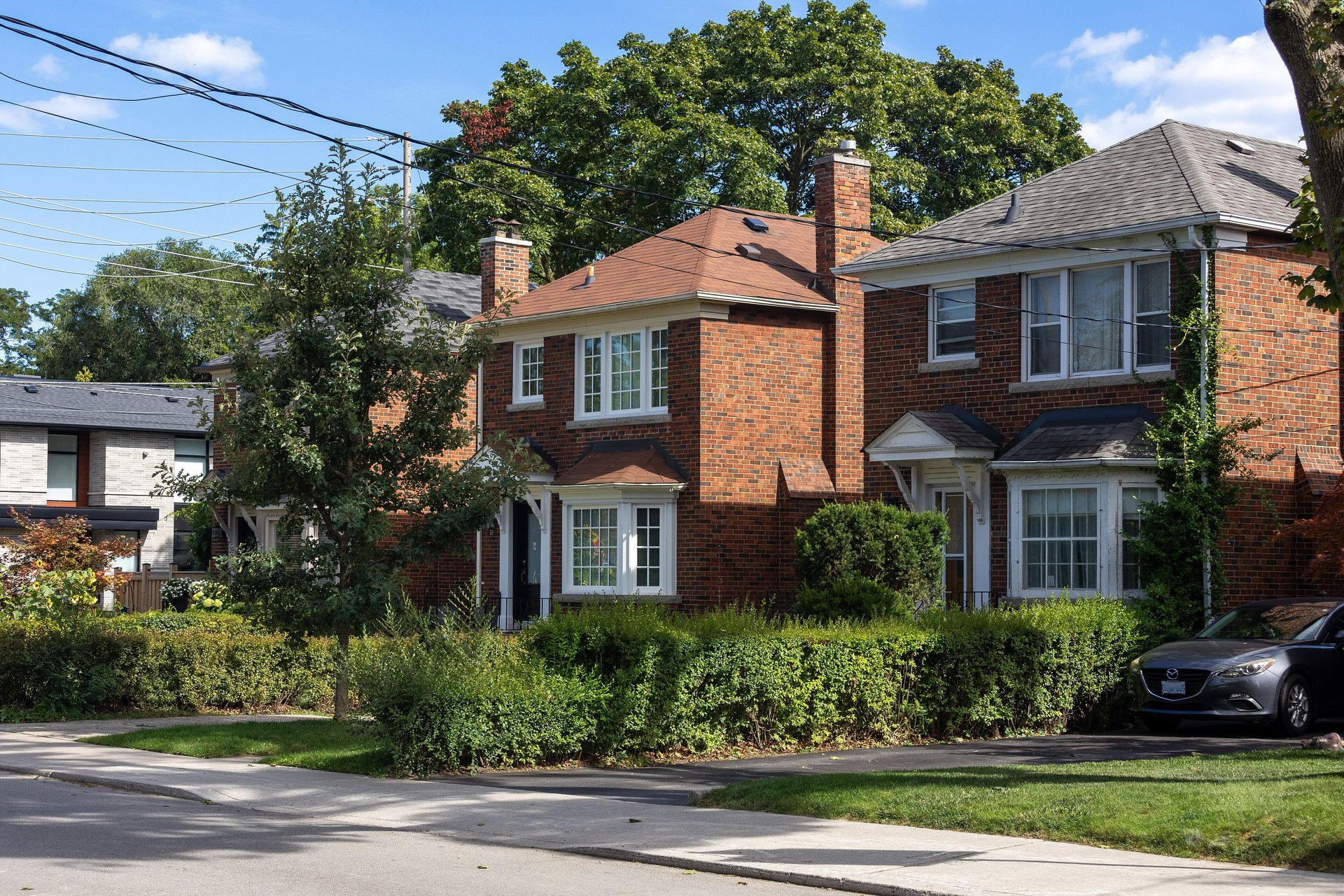
Photo credits: "Homes on Strathmore Blvd in Toronto, September 19 2026", "Homes on Harold Street in Mimico, Toronto, May 16 2026", "Old and New Homes on Coxwell Avenue in Toronto, August 6 2026" and "Homes on Rumsey Road in Leaside, Toronto, August 30 2025" by Dillan Payne (CC BY-SA 4.0); "NorthYorkHouseConstruction" by Raysonho (CC0). All via Wikimedia Commons.
